.png)
Essential Portuguese Phrases for the Workplace for Beginners in Portugal

Starting a job in Portugal can feel harder when the language around you moves quickly. A colleague says something in the break room, a supervisor gives an instruction, a customer asks a question, and suddenly even simple Portuguese feels difficult.
The good news is that you do not need perfect Portuguese to start communicating at work. A small set of clear, polite phrases can help you greet people, ask for help, understand tasks, and show that you are making an effort.
This guide focuses on European Portuguese, the Portuguese used in Portugal. The phrases are simple, practical, and useful for beginners who want to feel more confident at work.

Why workplace Portuguese matters in Portugal
Many workplaces in Portugal include people from different countries. In some jobs, colleagues or managers may speak English. In others, Portuguese is the main language for instructions, safety, customers, and daily routines.
Learning Portuguese phrases for the workplace helps with more than words. It helps you:
Understand what is expected of you
Ask questions before making mistakes
Build trust with colleagues and supervisors
Speak more comfortably with customers
Feel more included in the team
Improve future job opportunities in Portugal
It is normal to make mistakes. Most people will appreciate a respectful effort, especially when you use polite words such as por favor and obrigado/a.
A useful phrase to remember when you are still learning is:
Portuguese | English meaning | When to use it |
Estou a aprender português. | I am learning Portuguese. | Use this when someone speaks too fast or you need patience. |
Pode falar mais devagar, por favor? | Can you speak more slowly, please? | Use this with colleagues, supervisors, or customers. |
Não percebi. Pode repetir, por favor? | I didn’t understand. Can you repeat, please? | Use this when you miss an instruction. |
Greetings and introductions at work
Workplace communication often starts with a greeting. In Portugal, it is common to greet people when arriving, entering a room, or asking for help.
Basic greetings
Portuguese | English meaning | When to use it |
Bom dia. | Good morning. | Use until lunchtime. |
Boa tarde. | Good afternoon. | Use after lunch and during the afternoon. |
Boa noite. | Good evening or good night. | Use in the evening or when leaving at night. |
Olá. | Hello. | Friendly and informal. |
Até amanhã. | See you tomorrow. | Use when leaving work and returning the next day. |
Até logo. | See you later. | Use when you will see the person again soon. |
Introducing yourself
Portuguese | English meaning | When to use it |
Chamo-me Ana. | My name is Ana. | Use when introducing yourself. |
Sou o novo colega. | I am the new male colleague. | Use if you are male. |
Sou a nova colega. | I am the new female colleague. | Use if you are female. |
Trabalho na cozinha. | I work in the kitchen. | Change the workplace area as needed. |
Trabalho no armazém. | I work in the warehouse. | Useful for logistics or stock jobs. |
Muito prazer. | Nice to meet you. | Use after meeting someone new. |
In Portuguese, some words change depending on gender. For example, a man says obrigado and a woman says obrigada.
Asking for help or clarification
Asking questions is a strength, not a weakness. At work, it is better to ask than to guess, especially when instructions, customers, tools, or safety are involved.
When you do not understand
Portuguese | English meaning | Example situation |
Desculpe, não percebi. | Sorry, I didn’t understand. | A supervisor explains a task too quickly. |
Pode repetir, por favor? | Can you repeat, please? | You missed part of the instruction. |
Pode explicar outra vez? | Can you explain again? | You need the full explanation repeated. |
Pode mostrar-me? | Can you show me? | You need a demonstration. |
Como se diz isto em português? | How do you say this in Portuguese? | You want to learn the correct word. |
O que significa esta palavra? | What does this word mean? | You see a word on a sign or document. |
When you need help
Portuguese | English meaning | Example situation |
Pode ajudar-me, por favor? | Can you help me, please? | You are stuck with a task. |
Preciso de ajuda. | I need help. | Use when something is urgent or difficult. |
Tenho uma dúvida. | I have a question. | A polite way to ask before speaking. |
Não sei como fazer isto. | I don’t know how to do this. | Use when you need guidance. |
É assim? | Is it like this? | Use while checking if you are doing something correctly. |

Speaking with colleagues and supervisors
Work conversations often include short, repeated phrases. You may need to confirm tasks, explain progress, or ask what to do next.
Talking about tasks
Portuguese | English meaning | Example situation |
O que devo fazer agora? | What should I do now? | You have finished one task and need the next one. |
O que devo fazer a seguir? | What should I do next? | Similar meaning, very useful with supervisors. |
Já acabei. | I’ve finished. | Tell someone a task is complete. |
Ainda não acabei. | I haven’t finished yet. | Explain that a task is still in progress. |
Vou tratar disso. | I’ll take care of it. | Confirm that you will do the task. |
Está feito. | It’s done. | A short way to say something is finished. |
Confirming information
Portuguese | English meaning | Example situation |
Está bem. | OK. | Show that you accept or understand. |
Combinado. | Agreed. | Use after agreeing on a plan or time. |
Só para confirmar... | Just to confirm... | Use before repeating key details. |
Posso confirmar uma coisa? | Can I confirm something? | Use before checking an instruction. |
Então, faço isto primeiro? | So, do I do this first? | Use to check the order of tasks. |
Speaking politely to a supervisor
In Portugal, with supervisors or people you do not know well, it is often safer to use a polite form rather than tu. You can use pode and desculpe to sound respectful.
Portuguese | English meaning | Example situation |
Desculpe, posso falar consigo? | Excuse me, can I speak with you? | You need to speak to a supervisor. |
Tenho uma questão sobre o horário. | I have a question about the schedule. | You need to discuss working hours. |
Preciso de confirmar as instruções. | I need to confirm the instructions. | You want to avoid misunderstanding. |
Obrigado/a pela ajuda. | Thank you for the help. | Use after someone helps you. |
Understanding schedules, shifts, and instructions
Schedules are a common source of confusion for newcomers. Learn the words for shifts, days off, breaks, and deadlines.
Work schedules
Portuguese | English meaning | Example situation |
A que horas começo? | What time do I start? | Ask about your starting time. |
A que horas termino? | What time do I finish? | Ask about your finishing time. |
Qual é o meu horário? | What is my schedule? | Ask about your work timetable. |
Tenho folga amanhã? | Do I have a day off tomorrow? | Confirm your day off. |
Posso trocar de turno? | Can I change shifts? | Ask if a shift change is possible. |
A pausa é a que horas? | What time is the break? | Ask about break time. |
Qual é o prazo? | What is the deadline? | Ask when something must be finished. |
Common instruction words
Portuguese | English meaning | Example situation |
Agora | Now | A task must be done immediately. |
Depois | Afterwards | The task comes later. |
Antes | Before | Something must happen first. |
Primeiro | First | The first step in a process. |
A seguir | Next | The next step. |
Devagar | Slowly | Useful when handling something carefully. |
Com cuidado | Carefully | Common in safety instructions. |
If someone gives a long instruction, repeat the key point back in simple Portuguese:
Portuguese | English meaning |
Só para confirmar, faço isto primeiro e depois aquilo? | Just to confirm, I do this first and then that? |
Customer service phrases
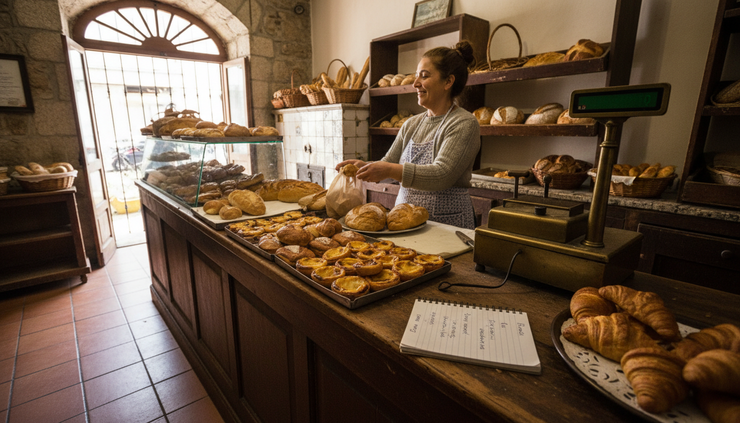
If you work in a café, shop, hotel, restaurant, reception, cleaning service, transport, or delivery role, customer phrases can help you sound polite and professional.
Greeting and helping customers
Portuguese | English meaning | Example situation |
Bom dia, em que posso ajudar? | Good morning, how can I help? | Use with customers in shops or reception. |
Precisa de ajuda? | Do you need help? | Use when a customer seems unsure. |
Um momento, por favor. | One moment, please. | Use when you need time. |
Vou chamar um colega. | I’ll call a colleague. | Use when someone else can help better. |
Pode aguardar um pouco? | Can you wait a little? | Use when there is a short delay. |
Payments, orders, and problems
Portuguese | English meaning | Example situation |
Quer fatura? | Do you want an invoice or receipt with tax details? | Common in shops and restaurants. |
Vai pagar em dinheiro ou com cartão? | Will you pay by cash or card? | Use at payment. |
Pode inserir o cartão, por favor. | Please insert the card. | Use at a card machine. |
Peço desculpa pelo incómodo. | I apologise for the inconvenience. | Use when there is a problem. |
Vou verificar. | I’ll check. | Use before checking stock, a booking, or an order. |
Já trago. | I’ll bring it shortly. | Useful in cafés and restaurants. |
Phone and email communication
Phone calls can be stressful because you cannot see body language. Keep your phrases short and clear.
Phone phrases
Portuguese | English meaning | Example situation |
Estou? | Hello? | Common when answering the phone in Portugal. |
Bom dia, fala a Maria. | Good morning, Maria speaking. | Use when answering a work call. |
Quem fala, por favor? | Who is speaking, please? | Ask who is calling. |
Estou a ligar sobre o trabalho. | I’m calling about work. | Explain the reason for your call. |
Pode repetir, por favor? | Can you repeat, please? | Very useful on the phone. |
A chamada está má. | The connection is bad. | Use when the line is unclear. |
Posso ligar mais tarde? | Can I call later? | Use if it is not a good time. |
Email and message phrases
Work emails in Portugal can be formal or simple, depending on the job. For many workplace messages, these phrases are enough.
Portuguese | English meaning | Example situation |
Bom dia, | Good morning, | A polite email opening. |
Envio em anexo... | I am sending attached... | Use when sending a file. |
Pode confirmar, por favor? | Can you confirm, please? | Ask for confirmation. |
Fico a aguardar a sua resposta. | I look forward to your reply. | A polite closing line. |
Obrigado/a. | Thank you. | Simple and useful. |
Cumprimentos, | Regards, | Common email closing. |
For a short message to a colleague, you can write:
Bom dia, pode confirmar o horário de amanhã, por favor? Obrigado/a.
Meaning: Good morning, can you confirm tomorrow’s schedule, please? Thank you.
Safety and workplace etiquette
Safety language is essential. If something is dangerous, unclear, broken, or urgent, do not stay silent.
Safety phrases
Portuguese | English meaning | Example situation |
Cuidado! | Careful! | Warn someone quickly. |
É perigoso? | Is it dangerous? | Ask before using something unfamiliar. |
Onde está a saída de emergência? | Where is the emergency exit? | Learn this early in any workplace. |
Onde está o kit de primeiros socorros? | Where is the first aid kit? | Useful in all workplaces. |
Tive um acidente. | I had an accident. | Use if you are injured or involved in an incident. |
A máquina não está a funcionar. | The machine is not working. | Report a problem. |
Há um problema. | There is a problem. | Simple phrase for urgent situations. |
Preciso de luvas. | I need gloves. | Change the item, such as mask or helmet. |
Polite workplace etiquette
Small polite phrases can change the tone of a conversation.
Portuguese | English meaning | When to use it |
Por favor. | Please. | Add to requests. |
Obrigado/a. | Thank you. | Use often. |
De nada. | You’re welcome. | Reply to thanks. |
Com licença. | Excuse me. | Passing by or interrupting politely. |
Desculpe. | Sorry or excuse me. | Apologising or getting attention. |
Não faz mal. | No problem. | Reassure someone after a small mistake. |
Sem problema. | No problem. | Friendly and common. |
Punctuality matters in many workplaces in Portugal. If you are late, say so clearly:
Portuguese | English meaning |
Peço desculpa pelo atraso. | I apologise for being late. |
Estou atrasado/a. | I am late. |
Chego daqui a dez minutos. | I will arrive in ten minutes. |
How Edpro supports practical Portuguese for work
Workplace Portuguese is easier to learn when lessons connect to real situations. Grammar matters, but many newcomers first need language they can use tomorrow at work: asking for help, understanding schedules, speaking to customers, and following safety instructions.
Edpro’s Practical Portuguese and Portuguese Language and Integration programmes are designed around this kind of daily communication. They can support learners who want to build confidence step by step, practise European Portuguese, and understand more about life and work in Portugal.
The aim is not to speak perfectly from day one. The aim is to communicate clearly, participate more fully, and keep improving.
Quick-reference list of the most useful workplace phrases
Keep this list on your phone or in a small notebook.
Portuguese | English meaning |
Bom dia. | Good morning. |
Chamo-me... | My name is... |
Estou a aprender português. | I am learning Portuguese. |
Pode falar mais devagar, por favor? | Can you speak more slowly, please? |
Pode repetir, por favor? | Can you repeat, please? |
Não percebi. | I didn’t understand. |
Pode ajudar-me, por favor? | Can you help me, please? |
Tenho uma dúvida. | I have a question. |
O que devo fazer agora? | What should I do now? |
Já acabei. | I’ve finished. |
Só para confirmar... | Just to confirm... |
Qual é o meu horário? | What is my schedule? |
A que horas começo? | What time do I start? |
Preciso de ajuda. | I need help. |
Cuidado! | Careful! |
Desculpe. | Sorry or excuse me. |
Obrigado/a. | Thank you. |
Com licença. | Excuse me. |
Está bem. | OK. |
Cumprimentos. | Regards. |

FAQ
Do I need fluent Portuguese to work in Portugal?
Not always. Some jobs require strong Portuguese, while others allow beginners to start with basic phrases. Even simple Portuguese can help you understand tasks, be polite, and feel more confident.
Is this European Portuguese or Brazilian Portuguese?
This guide uses European Portuguese, which is the form used in Portugal. Some phrases are similar in Brazil, but pronunciation and everyday wording can be different.
What is the best phrase to learn first?
Learn Pode repetir, por favor?, which means “Can you repeat, please?” It is useful in almost every workplace situation.
How can I practise Portuguese at work without feeling embarrassed?
Start with greetings, thank people in Portuguese, and ask short questions. You can also say Estou a aprender português, so colleagues know you are practising.
Should I use formal or informal Portuguese with my supervisor?
Use polite phrases such as desculpe, pode, and por favor unless your supervisor invites a more informal style. This sounds respectful and professional.
A final word for beginners
Learning Portuguese for work is a gradual process. Start with the phrases you need most often, repeat them every day, and add new words from your own job.
You do not need perfect grammar to make progress. Clear, polite communication already helps you work more safely, connect with colleagues, and build a stronger future in Portugal.


Comments